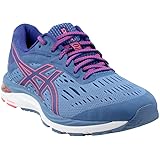
Rearfoot GEL Cushioning System: Attenuates shock during impact phase and allows for a smooth transition to midstance.
Removable Sockliner: A sockliner which can be removed to accommodate a medical orthotic.
Removable Sockliner: A sockliner which can be removed to accommodate a medical orthotic.
Trail Specific Outsole: Reversed lugs provide uphill and downhill traction on all types of terrain.
AHAR Outsole: Acronym for ASICS High Abrasion Rubber. Placed in critical areas of the outsole for exceptional durability.
Product description
With a redesigned midsole and upper, our new GEL-Venture® 6 delivers excellent shock absorbing comfort, so you can take on the trail. Your tread will benefit from the rugged, one-piece outsole, featuring multi-directional lugs for confidence-inspiring traction. From above, durable synthetic material and a stitched-down toe bumper ensure great fit, protection and comfort.
Our GEL-Nimbus 19 shoe features our revolutionary FlyteFoam Technology, for optimal comfort and a responsive ride for the neutral runner. A gradient jacquard-mesh upper is strategically tightened or loosened in zones to allow the foot's natural motion. 3D printed overlays provide seamless support to the upper.
Synthetic
Imported
Rubber sole
Shaft measures approximately low-top from arch
FlyteFoam Midsole Technology
Fluid Ride Midsole: Fluid Ride provides the ultimate combination of bounce back and cushioning properties with reduced weight and exceptional durability.
Rear foot and Forefoot GEL Cushioning Systems: Attenuates shock during impact and toe-off phases, and allows movement in multiple planes as the foot transitions through the gait cycle.
Fluid Fit Upper: ASICS Fluid Fit upper technology combines multi-directional stretch mesh with stretch reinforcements that adapt to the athlete's foot, creating a truly customized glove-like fit.
Heel Clutching System Technology: Exoskeletal heel counter provides improved support and creates improved heel fitting environment.
The tongue + chic exhibition will bring together an exciting selection of one-of-a-kind sneakers featuring collaborations with Trevor "Trouble" Andrew, KAWS, Daniel Arsham, Stash, Daniel "Mache" Gamache, theheyyman and Shantell Martin, among others. Curated by Elizabeth Semmelhack, Senior Curator at the Bata Shoe Museum in Toronto, in collaboration with Arnold Lehman, tongue + chic celebrates these utilitarian objects which have become highly coveted works that straddle the divide between fashion and art.
The exhibition is at PHILLIPS 450 Park Avenue, New York from 16 July – 31 August with viewing Monday-Friday 10am-6pm
Bad boy, defender, Jérôme Boateng (Bayern Munich, and Germany) may have been given an early bath for a second yellow card in the game against Sweden but it seems he can console himself with his 650 pairs of shoes in his personal collection.
DJ Bobbito Garcia is the critically acclaimed author of Where’d You Get Those? NYC’s Sneaker Culture: 1960-1987. As an award-winning filmmaker, Garcia has directed DOIN' IT IN THE PARK: PICK-UP BASKETBALL, NYC, STRETCH AND BOBBITO: RADIO THAT CHANGED LIVES, and his autobiographical documentary ROCK RUBBER 45s. Currently, "Kool Bob Love" produces his b-ball tournament Full Court 21™ in four continents, and co-hosts NPR's "What's Good With Stretch And Bobbito" podcast.
Zac Vine was working with inner city youth in Toronto. and noticed how imported kicks were to his class after a fight nearly ensued when one kid damaged another kid’s shoes. Intrigued, he began researching shoe and sneaker culture. At first, he showed his classes how they could repair their favourite trainers and make them look brand new. One of the class members asked him to customise his trainers and they were so impressed with the end result they suggest Vine post his artwork on Instagram.
The images soon caught the attention of Aroldis Chapman (then Cincinnati Reds), who arranged a meet. Chapman’s interest sparked an invitation from Nike and they invited Vine to their headquarters in Beaverton, Ore., where he was given an inside look at their design process and some of the materials they work with. He was also offered work with their sponsored athletes.
For professional reasons, Zac works under the tag Zeevy Customs and the shoe artists strips each sneaker removing any of the manufacturer’s finish, before re-dying and refashioning the sneakers by hand. He then customises the shoe to the client’s request using paintbrushes. He likes to avoid airbrushes or stencils preferring to work freestyle.
The artist painstakingly recreates images of family members or pets submitted by clients, and popular scenes such as José Bautista ’s infamous bat-flip for a pair of Jays-themed sneakers. He regularly accepts celebrity commission from people like, The Weeknd , Drake and Logic . According to the artist, it takes about 40 hours to complete one pair, or a week's work. He charges about $30 an hour to customize a shoe and sells his one-off sneakers from prices ranging from $1,000 to $3,000.
Despite his resounding success the Canadian shoe artist missed helping kids, so he started teaching again as a substitute at Journey Middle School. After going full time, he combined the two interests and created the Fresh SOLES program, where students are able to paint their own sneakers.
From an actual jail in England to a pretend jail in Nike advertisements, sneakers have always made a statement without saying a word. In this episode, Trailblazers with Walter Isaacson looks into how they fit into the sport and fashion landscape – both on and off the field of play.
The adidas Solar Boost, was inspired, at least in part, by NASA engineering and is one of the new lightweight running shoes (295 grams - 10.4 ounces in a men’s 8.5 UK). According to adidas, the shoe uses data-driven Tailored Fibre Placement that implements Parley material (recycled ocean plastic) within its fibres at the midfoot for support. The shoe is precisely stitched and constructed using data from the Aramis system motion capture system, and the shoes are available in a wider fit with a counter designed to allow free motion of the Achilles tendon.
By comparison, according to the manufacturer, tests conducted by independents, showed the adidas Solar Boost gave higher energy return with each stride than the Nike Epic React Flyknit, which was attributed to the cushioned Boost midsole, supported by the Stretchweb outsole, used for extra traction. The shoe has a new mesh upper, made of Parley yarns, and connected to the sole via the brand’s patented Solar Rail. This plastic-like layer runs along the sole and gives support for your foot, and works in partnership with the Torsion Bar stretching from heel to forefoot.
The ability to harness energy by integrating micro-technology into the soles of shoes has great protentional (absolutely no pun intended), however, applications to date have been very limited. Electrical energy generated from biomechanical movement e.g. walking, can only produce fluctuating amplitude and variable frequencies. The output is alternating current (AC), which can only power applications such as LED lighting. To energise mobile devices etc., the high voltage and low current needs to be converted to low voltage and higher current (DC), and this requires a (heavy) transformer.
A step forward came when the researchers at the School of Materials Science and Engineering at Georgia Institue of Technology used a triboelectric nanogenerator (TENG) based shoe insole to produce a maximum output voltage and current density up to 220 V and 40 mA, respectively when the wearer was walking.
(Video Courtesy: Wisconsin Mrsec Youtube Channel)
The two phase procedure involved a small capacitor which captured the alternating current generated by walking. In the second phase, the electricity was feed into a battery which supplied DC current at voltages appropriate for powering wearable and mobile devices. By matching the impedance of the storage device to triboelectric generators, energy efficiency was increased up to 60 percent. The triboelectric effect takes advantage of the fact that certain materials become electrically charged after they come into moving contact with a surface made from a different material. According to the researchers, the power management system converted the fluctuating power amplitudes and variable frequencies to a continuous direct current, which could drive just about any device. Although further research and development is ongoing the future for high tech footwear is looking good.
One reason for the recent increase in presence of ath-lesure footwear in CBDs is the relaxation of office dress codes including the rise of casual Friday or dress down days at the office. An increasing number of companies now invite their employees to participate and wear casual attire including sneakers to work. This 'casualization of fashion footwear,' has come as a bonus to the sneaker manufacturers whilst more traditional shoe manufacturers continue to struggle in the high street.
Fashion crossover from sport to high street takes many forms but in the case of trainers it started with industrial action in the transport industry in North American cities. Thousands of commuters were sent scrambling to their closets for comfortable shoes to walk to work. The aerobic craze of the 70s and the jogging and running boommeant the humble canvas topped shoes had gone through a fashion facelift and designer trainers were seen everywhere from streets, playing fields, gymnasia to catwalks. A hybrid shoe design soon emerged , this was called the cross trainer. The generic sports shoe incorporated the good fitting features along with the ideal of a shoe designed for recreational physical activity. New polymer materials allowed the combination of lightweight strong uppers with well supported and robust outsoles.
The new generation of trainers are smartshoes, trainers with an electronic edge. These typically feature a Bluetooth-connected accessory (usually insoles) that link activity or location to a smartphone app. Typically these count daily steps and calculate calorie intake, sort of thing. However, there is no end to the smart-shoe possibilities: from ordering dinner and displaying works of art to evading spills and biodegrading. Nothing says innovation like high-tops that order pizza and pause live TV. Presently the smart shoe market is dominated by big names (Nike, Under Armour, and adidas) although some relative unknowns (Salted Venture, Daphne, 361) are making their presence felt too.
,br> The much sought after, Pulisic is a lifelong fan of Hershey chocolate is proud to wear his new cleats and said. “It’s a dream come true to partner with Hershey. I literally feel as happy as a kid in a candy store.”
The Hershey Company confirmed there are 10 more pairs in existence, but these are not available for purchase.
The technology of shoe making has radically changed in the last quarter of century. Not only are shoe designs different the manner in which they are made and tested has also altered beyond recognition. Material labs help build shoes from scratch by creating new polymer mixes and adjusting sole moldings to suit foot function. New materials are tested in space age labs which include climate chambers to replicate almost any condition on earth, and also sophisticated biomechanics laboratories. A good example is the new Asics Gel-Kayano, was developed at the Asics Institute of Sport Science in Kobe, Japan.
The original trainer was launched in 1993 and incorporated a combination of suede and mesh overlays with different gels sandwiched into the midsoles of the rearfoot and forefoot. The sixth version was released seven years later, and was constructed to absorb impact of peak force. A decade on, the 16th generation in 2010, aimed to stabilize a runner’s foot by keeping it straight during stance phase of running. The 23rd version was 55 % lighter than the industry standard and incorporated FlyteFoam®.
For the 25th anniversary model, designers created two new styles of FlyteFoam® i.e. Lyte and Propel. FlyteFoam Lyte contains nanofibers trapped between air bubbles which makes the thinner midsoles lighter (under 12 ounces) than previous models but also increases both the strength and durability than conventional EVA foam.
Nicholas Smith’s “Kicks: The Great American Story of Sneakers” (Crown, 320 pages, $26) describes the cultural history of America’s most fetishized object i.e, The Sneaker. From the humble origins of rubber soled canvas topped shoes in the mid 19th century and the rise of leisure among the masses he describes the evolving sportshoe and its integration into codified games and athletics, Tracing the impact of sport shoe giants such as adidas and Nike, he considers the cultural significance of ‘rubbers’, in today’s ashfelt jungle and celebrity culture. “Kicks” is a must for all ‘sneakerfreakers.’
Sneakers: An American Tale From the high-end to low-end, high-tops to trainers, what makes a sneaker great, and what is it about athletic shoes that make them such a symbol of Americanness? Listen to a penel of experts.
Just as the POTUS banned Irn Bru from his Scottish Golf Resorts , Vans have released a blue, orange and white pattern sneaker in almost the exact same shade as the famous Scottish beverage. Fashion and Irn-Bru lovers alike have been sent into a frenzy over the new kicks.
The Vans Anaheim Old Skool style in the ‘OG Blue and Gold’ colourway have proven so popular they have sold out at online retailer ASOS. Dubbed ‘Vans like cans’, I wonder who will be the first at Trump’s Scottish resorts to tee off, wearing them ?
Adidas wants to be the first shoe company to implement large-scale production using 3D printing, whilst rivals Nike, Under Armour and New Balance are undertaking their own 3D printing experiments. Adidas, now in partnership with Carbon , a US-based vat polymerization 3D printing company, intend to start production on the Futurecraft sole. Vat polymerization refers to a number of 3D printing technologies that all build up an object in a vat of photopolymer using a laser or other light source. Adidas has announced that it plans to 3D print 100,000 shoe soles of its Futurecraft 4 shoe by 2018. The current manufacturing costs are higher than a shoe made in Asia with traditional methods, but the German company may eventually relocate their production of shoes away from Asia, to highly automated factories in Germany. Approximately four million people are employed in Bangladesh’s garment industry which is responsible for 81% of that economy’s exports.
Tyler George (US) is a curler at the Pyeongchang Olympics. He likes his Skechers and has worn them for eight years at will not change them even for the Winter Olympics. Tyler initially intended them for casual wear but found them so comfortable he put Teflon plates on the soles to wear for curling. Now the well worn shoes fit like the proverbial glove and are ideal for curling. The much loved shoes were going to be patched up for the games but Tyler declined and instead had up graded his sporting socks featuring superheroes. In curling it is common for paprticipant to stick to shoes they trust and will like Tyler wear them literally iuntil they fall apart.
Ander Mirambell is a Spanish skeleton racer who has competed since 2005. The former track and field athlete initially wanted to try his hand at bobsleigh, but was unable to fund the costs and so turned his attentions to another sliding sport at the International Bobsleigh and Skeleton Federation (IBSF). After renting his a sled and buying a helmet, he did not have enough money to buy the specialised shoes required for the push off. Not wanting to be put off he took a cheese grater and fine sandpaper to his old running spikes, to create his own prototype push off shoes. Despite coming under severe scrutiny at the IBSF, he was eventually given a pair of second-hand shoes in which to train.